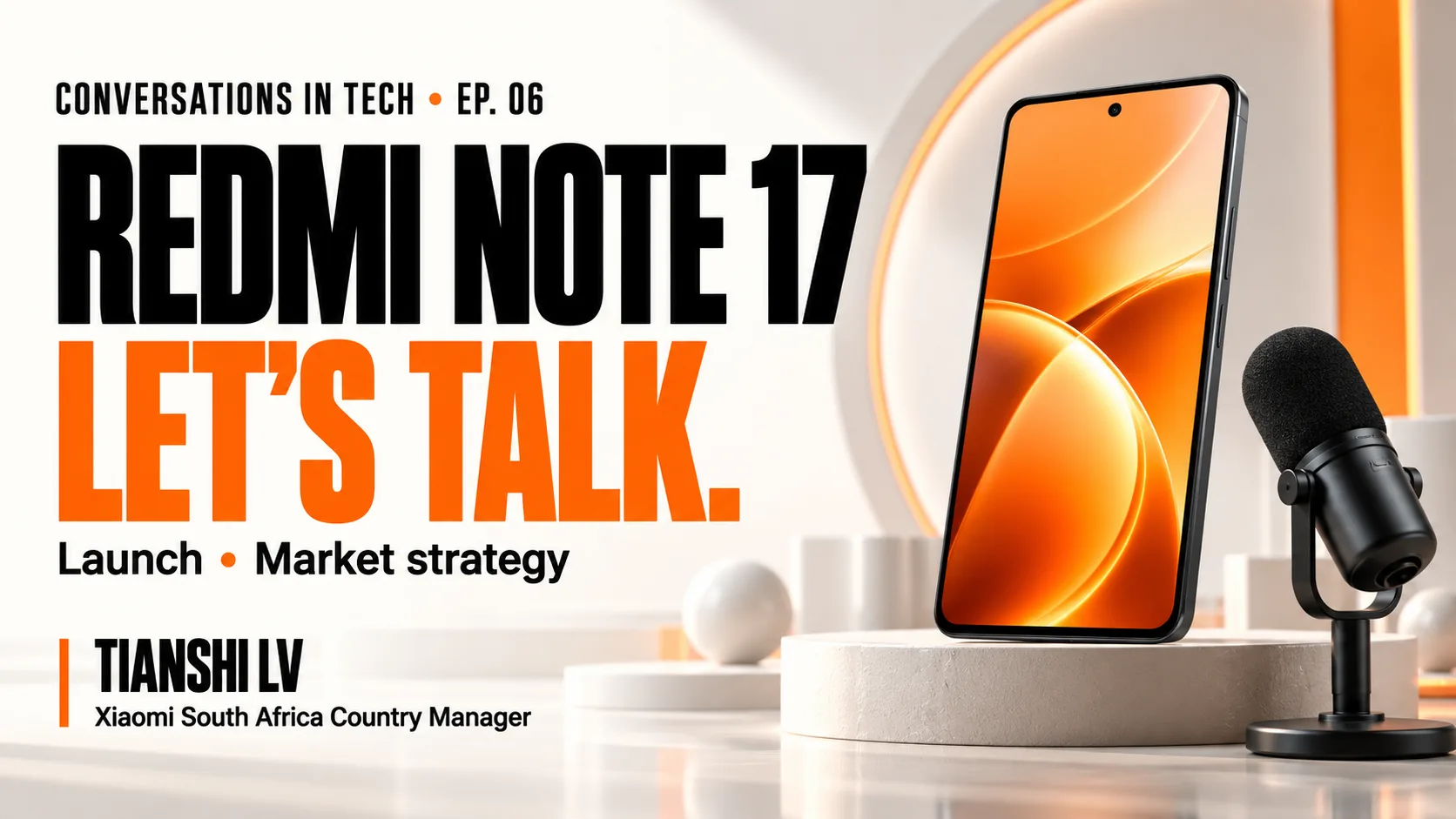
Xiaomi is setting its sights on bigger things in South Africa, with plans to expand its product portfolio, strengthen its retail presence and bring more innovative technology to local consumers. In an exclusive interview on Conversations in Tech, Xiaomi South Africa Country Manager Tianshi Lv shared his vision for the brand, discussing everything from the recently launched Redmi Note 17 series and smart home devices to the possibility of Xiaomi electric vehicles eventually making their way to South African roads.
Since taking over as Country Manager of Xiaomi South Africa in March 2026, Lv has made it clear that the country represents more than just another market for the global technology brand. It is a strategic market with significant growth potential. And if Xiaomi’s ambitions are anything to go by, the company wants to become an even bigger part of South Africans’ everyday technology experiences.
Xiaomi South Africa’s New Country Manager Has Big Plans
Tianshi Lv brings considerable international experience to his new position. Before moving to South Africa, he served as Xiaomi’s Country Manager in Peru from March 2020 until March 2026. During his tenure, Xiaomi grew its market share in Peru from approximately 1% to 30%, according to figures referenced in the interview from Omdia, formerly Canalys. That experience provides an interesting indication of what Xiaomi hopes to achieve in South Africa.
Lv says his first few months in the country have been an exciting experience, highlighting South Africa’s cultural diversity, friendly people and enthusiasm for technology. He believes these characteristics align closely with Xiaomi’s mission of making innovative technology accessible through products that offer excellent value. For Xiaomi, the opportunity is clear: South African consumers are increasingly interested in technology that improves their everyday lives, whether through smartphones, entertainment, productivity or connected home devices.
Redmi Note 17 Series Brings Flagship Features to the Mid-Range Market
One of Xiaomi’s biggest recent announcements in South Africa has been the introduction of its Redmi Note 17 smartphone series. The launch represents an important step in the company’s efforts to bring more advanced smartphone technology into the mid-range market. Leading the range is the Redmi Note 17 Pro Max 5G, which Xiaomi says combines powerful specifications, improved durability and advanced artificial intelligence features.
Some of its headline specifications include:
- 10,000mAh battery: Designed to provide extended battery life, with Xiaomi highlighting the potential for up to three days of use.
- 100W HyperCharge: High-speed charging designed to reduce downtime.
- Advanced water resistance: IP66, IP68, IP69 and IP69K certifications.
- Drop resistance: SGS-certified durability.
- Google Gemini: AI-powered assistance integrated into the smartphone experience.
- Circle to Search: Making it easier to search for information directly from the screen.
- Xiaomi HyperAI: Including AI Writing, AI Interpreter and AI Dynamic Wallpapers.
Importantly, Xiaomi has also confirmed that all three devices introduced in the Redmi Note 17 series are 5G-enabled. The range includes the Redmi Note 17 Pro Max 5G, Redmi Note 17 Pro 5G and Redmi Note 17 5G, giving consumers different options depending on their requirements and budgets.
For Lv, the thinking behind the launch is straightforward. South African consumers want smartphones that can handle everyday work, entertainment and content creation without compromising on reliability or performance. Long battery life, durability, fast charging and AI capabilities are therefore becoming increasingly important considerations. Xiaomi believes the Redmi Note 17 series addresses these expectations while bringing features traditionally associated with flagship smartphones into a more accessible price category.
Xiaomi and Redmi: Understanding the Difference
One of the interesting topics discussed during the interview was the distinction between Xiaomi and Redmi. Although many South African consumers associate Redmi primarily with affordable smartphones, the brand’s positioning is considerably broader. Lv explained that Xiaomi operates through a structured brand ecosystem designed to serve different consumer groups and technology needs. At the top is the main Xiaomi brand, represented by its familiar orange logo. This serves as the company’s master brand and encompasses its wider product ecosystem.
Below that are several product sub-brands, each with its own focus:
- Xiaomi: Focuses on high-end, cutting-edge technology and premium experiences.
- Redmi: Targets younger, trend-driven consumers looking for accessible technology and strong value.
- POCO: Focuses on performance-driven users.
- Mijia: Concentrates on smart, human-centric living.
- Cyber: Represents the company’s exploration of future technologies.
Xiaomi also has a third layer consisting of its technology platforms and innovations. These include HyperOS, HyperAI, Xiaomi MiMo and the company’s XRing chipset technology. Together, these technologies help connect Xiaomi’s products and create a more integrated ecosystem. The distinction is particularly important in South Africa, where Redmi has traditionally been associated with entry-level and budget smartphones. With the introduction of more premium Redmi Note devices, Xiaomi wants consumers to recognise that Redmi offers more than just affordable entry-level handsets.
Xiaomi Wants Its Products to Be More Accessible to South Africans
Beyond introducing new smartphones, Xiaomi is looking at ways to make its products easier to purchase across South Africa. During the interview, Lv highlighted the importance of building a complete product portfolio while expanding the company’s distribution network. This includes working closely with mobile network operators, retailers, independent dealers and e-commerce platforms.
The company recognises that South Africa has a diverse consumer market, where purchasing preferences vary significantly. Some consumers prefer buying their smartphones outright through prepaid channels, while others rely on monthly contracts or retailer-based payment arrangements. Xiaomi says it wants to support both prepaid and postpaid customers.
The company’s approach is to ensure that consumers can purchase their preferred Xiaomi products through the channels and payment solutions that work best for them. Partnerships with operators such as MTN and Vodacom, alongside established retail groups and online platforms, could therefore play an important role in expanding Xiaomi’s footprint. For consumers, broader distribution could mean easier access to Xiaomi’s higher-end smartphones without necessarily having to pay the full retail price upfront.
South Africa is a Strategic Market for Xiaomi
One of the strongest messages from the interview was Xiaomi’s confidence in the South African market. While some international technology companies may view African markets primarily through the lens of affordability and purchasing power, Lv believes there is considerably more opportunity. He described South Africa as both an important and strategic market for Xiaomi.
The company’s interest is driven by the size of the market, consumers’ enthusiasm for technology and the opportunity to introduce more innovative products. Lv also pointed to Xiaomi’s experience in Peru as an example of what can happen when the company invests in understanding local consumers. Growing from approximately 1% to 30% market share in Peru demonstrated the potential of Xiaomi’s user-centric approach.
The strategy involves three key priorities:
- Building stronger brand awareness and telling the Xiaomi story.
- Introducing a wider range of products to serve different consumer needs.
- Expanding distribution so customers can purchase Xiaomi products wherever it is convenient for them.
The company believes these priorities will be equally important in South Africa.
Could Xiaomi Start Manufacturing in South Africa?
With several international automotive and technology brands investing in local manufacturing, the possibility of Xiaomi establishing manufacturing operations in South Africa was another interesting discussion point. When asked whether Xiaomi might consider manufacturing locally, Lv did not reveal any concrete plans.
However, he reiterated that South Africa is an important market and that the company intends to become increasingly localised. For now, there is no confirmed announcement regarding local smartphone manufacturing facilities.
Nevertheless, Xiaomi’s commitment to growing its South African operations could create interesting possibilities for the future. Local manufacturing would potentially represent a significant development for the company’s presence in the country, although it remains to be seen whether this is something Xiaomi will pursue.
Xiaomi Is Already Making Waves in South Africa’s Smart Home Market
While smartphones remain a major part of Xiaomi’s business, the company’s connected home ecosystem is another area where it has established a presence in South Africa. Its portfolio includes products such as robot vacuum cleaners, smart televisions, TV boxes, humidifiers and other Internet of Things (IoT) devices.
Interestingly, Lv revealed that Xiaomi is the number one robot vacuum brand in South Africa. This is a notable achievement and highlights how the company has managed to build recognition beyond the traditional smartphone market. Xiaomi also sees its smart home products and smartphones as closely connected. According to Lv, the smartphone effectively serves as the control centre for the wider IoT ecosystem, allowing consumers to manage and interact with their connected devices. This is where Xiaomi’s broader Human × Car × Home strategy comes into play.
The strategy connects three major areas of technology:
- Human: Personal computing and devices that support everyday life.
- Car: Intelligent mobility and connected transportation.
- Home: Smart living spaces powered by connected devices.
The company wants to expand this ecosystem in South Africa by introducing more IoT products and giving consumers access to a wider range of connected technology. During the Redmi Note 17 series launch, Xiaomi also introduced additional products, including a smart TV, electric scooters and its latest robot vacuum offering. Lv confirmed that bringing more innovative IoT products to South Africa remains an important priority.
Xiaomi Electric Cars in South Africa: Is It Happening?
Perhaps one of the most anticipated questions among Xiaomi enthusiasts is whether the company’s electric vehicles will eventually make their way to South Africa. Xiaomi Auto has become a significant part of the company’s global ambitions, with the automotive business forming one of the pillars of its Human × Car × Home strategy. During the interview, Lv highlighted that Xiaomi had delivered more than 700,000 vehicles in approximately two and a half years. He also confirmed that Xiaomi had announced plans to enter the European market in 2027.
However, South African consumers hoping to see Xiaomi electric vehicles on local roads will have to wait a little longer. Lv confirmed that there is currently no information available regarding a South African launch. He did, however, reiterate that South Africa is a strategic market for Xiaomi and that the company remains committed to introducing more of its products locally.
While this does not confirm the arrival of Xiaomi electric vehicles, the company’s global automotive ambitions make it an interesting development to watch. Given the growing interest in electric vehicles in South Africa, an eventual local launch would certainly generate considerable attention.
More Xiaomi Experience Stores Could Be on the Cards
Another important part of Xiaomi’s growth strategy involves allowing consumers to experience its products before making a purchase. Currently, Xiaomi has experience stores at Canal Walk in Cape Town and Sandton City in Johannesburg. These stores provide an opportunity for consumers to interact with the company’s smartphones, smart home devices and other products.
Lv explained that Xiaomi has achieved success with its retail store model in several international markets. The stores are designed to showcase more than individual products. They allow consumers to experience how different devices work together as part of the broader Xiaomi ecosystem.
However, Xiaomi has not confirmed any specific plans to open additional experience stores in South Africa. The company is nevertheless exploring ways to increase consumer awareness through product launches, media partnerships, influencers and other marketing activities. Lv indicated that the South African team is passionate about telling the Xiaomi story and helping more consumers understand what the brand has to offer.
What Does the Future Hold for Xiaomi South Africa?
If there is one thing that became clear during the conversation with Tianshi Lv, it is that Xiaomi wants to build a much stronger presence in South Africa. The company is not simply looking to sell more smartphones. It wants to establish a broader technology ecosystem that connects mobile devices, smart homes and potentially, in the future, electric vehicles. The Redmi Note 17 series represents an important part of that strategy, particularly as Xiaomi looks to compete more aggressively in the mid-range smartphone segment.
At the same time, expanding its IoT portfolio, strengthening retail partnerships and improving product accessibility will be essential to its long-term success. There are still unanswered questions around local manufacturing, additional experience stores and the arrival of Xiaomi electric vehicles.
However, Lv’s message was clear: South Africa is a market Xiaomi believes in, and the company intends to keep investing in bringing more technology to local consumers. With a new leadership chapter underway and an expanding product ecosystem, it will be interesting to see just how far Xiaomi can take its South African ambitions over the coming years.